What is this peptide?
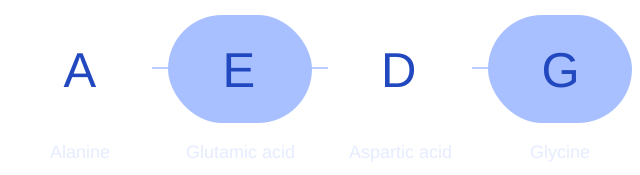
Epitalon contains alanine, glutamic acid, aspartic acid and glycine, arranged in the sequence Ala-Glu-Asp-Gly, or AEDG. A chain of four amino acids is called a tetrapeptide.
Epitalon’s development grew out of research into the pineal gland, a small structure in the brain involved in melatonin production and the sleep–wake cycle. Researchers investigated whether short peptides associated with this gland could influence age-related biological changes.
Two names often cause confusion. Epitalon and Epithalon refer to the same peptide. Epithalamin refers to a different preparation derived from pineal gland tissue. Findings involving that extract should not automatically be treated as evidence for the synthetic molecule.
Potential benefits and how they are being studied
Interest in Epitalon mainly centers on cellular aging and sleep regulation. These areas involve different biological processes, so a finding in one does not establish benefits in the other.
Telomeres and cellular aging
Telomeres are protective structures at the ends of chromosomes. They help preserve genetic material and can shorten as cells divide. When they become critically short, they can contribute to cellular senescence—a state in which cells stop dividing.
Telomerase is an enzyme that helps maintain these chromosome ends. Experiments have examined whether Epitalon can influence its activity and alter telomere length.
A 2025 cell-culture study reported telomere lengthening in normal human cells alongside increased telomerase activity. It also found effects in cancer cell lines through an alternative telomere-maintenance pathway.
These findings help explain the interest in longevity, but they do not demonstrate rejuvenation in people. Human cells grown in a laboratory are not the same as human participants receiving treatment.
Our guide to telomeres and cellular aging explains the proposed mechanism and its limitations.
Melatonin and sleep–wake rhythms
Melatonin helps signal biological nighttime. Its release follows a daily rhythm influenced by light and the body’s internal clock.
Pineal peptide research has explored changes in melatonin secretion and other hormone rhythms. This provides a reason to investigate sleep-related effects, but a change in hormone levels does not necessarily mean better sleep.
For someone with insomnia, useful outcomes would include falling asleep sooner, waking less often and functioning better during the day. Those outcomes need direct assessment in controlled human studies.
Longevity and healthy aging
Longevity means length of life. Healthspan refers to the years spent in good health. Neither can be measured by a single change in telomere length.
A treatment might affect a cellular marker without reducing disease, preserving independence or extending life. Claims about anti-aging benefits therefore need evidence beyond laboratory measurements.
Human use and what the evidence can tell us
People encounter Epitalon through longevity clinics, online discussions and products marketed for research. Interest in human use is separate from proof that a particular treatment works.
When assessing a claim, check three things:
- The substance: Was the study testing the synthetic tetrapeptide or a pineal gland extract?
- The participants: Did it involve people, animals or isolated cells?
- The outcome: Did it measure a meaningful health improvement or only a biological marker?
Personal reports may describe changes in sleep, energy or well-being. They cannot establish cause and effect because expectations, other treatments and normal day-to-day variation can influence those experiences.
There is no established anti-aging dosing protocol supported by robust clinical evidence. A schedule shared online should not be treated as a validated prescription.
Safety and side effects
The available evidence does not provide a dependable picture of common side effects, their frequency or long-term risks.
The FDA’s safety information on compounded peptides identifies concerns about potential immune reactions associated with aggregation and peptide-related impurities. It also notes insufficient safety information for the proposed administration route.
Product quality is a separate issue from Epitalon’s biological effects. A purity percentage alone does not establish sterility, correct concentration or suitability for injection.
Telomere maintenance also matters in cancer biology. Laboratory findings cannot establish that Epitalon causes cancer in people, but they cannot justify describing it as cancer-safe either.
Before considering Epitalon use, discuss the evidence, your medical history and current medications with a qualified clinician. The guide to side effects and safety considerations examines these questions in more detail.
Common questions
Are the two spellings different products?
Epitalon and Epithalon are alternative spellings for the same tetrapeptide. Product labels should still identify the actual substance and formulation.
Is it the same as melatonin?
No. Melatonin is a hormone involved in circadian timing. Epitalon is a different molecule investigated partly for its possible effects on pineal function and hormone regulation.
Does longer telomere length mean a longer life?
Not necessarily. Telomere length is one part of a much larger biological picture. A laboratory change does not predict how long a person will live or how healthy they will remain.
Is a research-use label proof of safety?
No. That label does not establish medical approval, clinical effectiveness or manufacturing standards suitable for human treatment.